
“Extinction of Experience”?
Ryan Shea
From In Context #55 (Spring 2026) | View Article as PDF
The Xerces blue (Glaucopsyche xerces) was a small iridescent blue butterfly with thick dark brownish bands at the periphery and a thin brilliant white outline going around the perimeter of its wings. It was last seen in the San Francisco Bay area in the early 1940s. This butterfly is thought to be the first documented case in the United States of an insect going extinct due entirely to humans, in this case habitat loss caused by industrial and residential development.
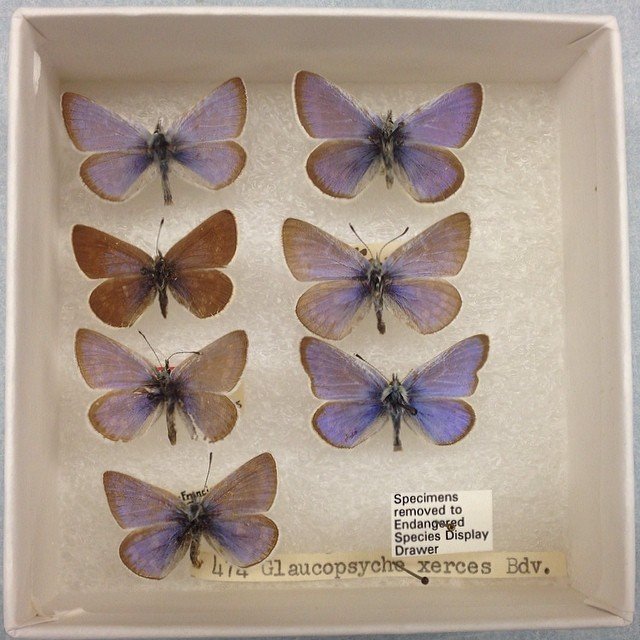
The extinct Xerces blue. The Xerces Society for Invertebrate Conservation, founded by Robert Michael Pyle, was named in its honor.
When a species of organism — Xerces blue, dodo bird, passenger pigeon — goes extinct, then we have a sense that something important has been lost. Every animal that is born will, of course, die. The same is true of plants and fungi. Death is not the antithesis of life, but rather its antagonistically complementary polarity. Just as exhaling our breath is in a way opposed to breathing in, yet the two need each other and go together. The death of an individual organism is not only an essential part of its own life cycle, but also feeds the life around it. The ecology of an oak tree is as much an ecology of death as an ecology of life. Yet, the Boynton oak (Quercus boyntonii) in Alabama is critically endangered, as are around thirty percent of known oak species. When the Boynton oak goes extinct, it will not be like the death of an individual, but a new kind of loss. A whole way of being in the world will have been removed from the face of the earth.
The January 2026 issue of Nature, one of the most prestigious science journals, had a feature piece titled “The Future of Fieldwork in the Age of AI.” The Nature article documents the decline of fieldwork, beginning with an anecdote about a plant ecologist who did his dissertation research on the phenology of plant flowering, but who “didn’t touch a single petal.” Rather, he “developed a machine-learning algorithm to analyze the digitized captions of one million herbarium specimens.”
Contemporary biologists and especially ecologists are awash in a sea of data. How does one reckon with millions, or billions, of data-points? To deal with this problem, many ecologists have become skilled computer programmers and spend much of their time writing code for tailor-made programs to help them find patterns in the overwhelming amount of information they have available. Algorithms and computer programs, now amplified by AI, are used in order to interpret findings. Such interpretations are usually considered to be the primary work of science. As the ecological philosopher Timothy Morton said, “That’s what scientists do: they look for patterns in data” (Morton 2025, p. xxxii). A statement that would reward prolonged reflection. The Nature article quotes a marine scientist who puts things in an even stronger way. He says that the ecologist’s job is to “extract ecological meaning from the data.” Note the language of an extraction economy, applied to data as a kind of raw material on which computer amplified pattern seeking is the value added.
Such use of computer programs in science for interpreting data is as old as computers themselves. The new trend that the article focuses on is the increased use of data capture devices, such as field cameras, that are always on and always recording. Not only has technology been introduced to find meaning in the data, but now technologies are doing the work of harvesting the data in the first place. A contemporary field ecologist might find themselves in a situation where their only “field work” is installing and repairing cameras, sound recording microphones, and other similar devices and their “reflective work” is mainly programming and debugging computer programs. In detailing these trends, the Nature article had a section titled, simply, “Extinction of Experience.”
This phrase was coined by the conservation ecologist Robert Michael Pyle in his 1993 book Thunder Tree: Lessons in an Urban Wildland. It struck a chord with many biologists, especially ecologists, and led to a handful of studies on the decline of fieldwork. The term also had wider resonances in the more mainstream modern culture, exemplified by Christine Rosen’s 2024 book The Extinction of Experience: Being Human in a Disembodied World. Rosen’s focus is how technology, especially our various screens and devices, have come to be ubiquitous mediating powers for most people for most of their waking lives in the modern world. Her introduction begins with a quote from Max Frisch’s novel Homo Faber, “Technology . . . the knack of arranging the world so that we need not experience it.”
The issue of direct, unmediated, embodied experience going extinct is not only a problem for contemporary field scientists, but for our culture as a whole. Rosen is yet another voice in the growing concern about our modern disconnection, e.g., think of Jonathan Haidt’s popular book The Anxious Generation. The problems documented by Rosen, Haidt, and other similar authors is of course extremely concerning, especially for parents who are witnessing the deterioration of their child’s capacity to be fully and immediately involved in whatever they are doing for more than two minutes at a time.
The term “extinction of experience” is powerful and troubling. Many might, like me, find it profoundly unsettling. But we need to slow down a little bit and see if we can go deeper. What, exactly, does “extinction of experience” mean? A child playing video games, a couple on a date both looking at their phones instead of talking, a field ecologist fixing a motion sensor camera high in a maple tree or writing code for processing their reams of data on the migration patterns of bobolinks — all of them are still experiencing something: the video game screen, the app of their phone, the irritating camera that refuses to work, the code processing program. It is not experience, as such, that has gone extinct, but a specific kind of experience. What is this specific kind of experience and what does it mean for it to go extinct? Here we come up against one of the main difficulties raised by Pyle’s phrase and the articles and books that have come in its wake. When the Xerces blue goes extinct, we have a clearer conception of what that means. There used to be a particular species of blue butterfly in California that would fly around, mate, lay eggs, grow, eat, and repeat. Now, all of them have died and there will never be another Xerces blue flying around in the world.
Pyle originally coined the term in an essay where he was reflecting on what “endangered” and “extinct” mean in common conservation activism. Pyle is an entomologist, not only that, he is a lepidopterist, focusing on butterflies. His point was that, although there have been precipitous declines in the numbers of many insect species, they are not considered endangered because there are still hundreds of millions of them. In other words, our notions of “endangered” and “critically endangered” were developed when speaking about charismatic large mammals, e.g., pandas and koalas, and do not make much sense when speaking about insects. When absolute numbers of some particular species of insect decline, they might still be in no danger of global eradication. Yet they will cease to exist in a myriad of particular bioregions. Pyle calls this “extinction at the local level.” It is in the context of such “local extinction” that he speaks of the “extinction of experience.” He explains, “simply stated, the loss of neighborhood species endangers our experience of nature. If a species becomes extinct within our own radius of reach (smaller for the very old, very young, disabled, and poor), it might as well be gone altogether, in one important sense. To those whose access suffers by it, local extinction has much the same result as global eradication” (Pyle 1993, p. 145).
The point he is making here is subtle and important. Yet, it raises a question. The purpose of this short note is to do little more than raise the question; to put it as bluntly as possible, “So what?” When the passenger pigeon is shot from the sky until it has been utterly annihilated, then a real kind of being has gone out of existence. There are no more passenger pigeons in the world. But if I, in walking down the streets of New York City, simply ignore all the pigeons flying around me, then does that affect anything? Does anything stop existing when our “experience” of pigeons goes extinct? If the New York pigeons are unattended to, are entirely unexperienced, by all the millions of New Yorkers who are all looking down and are entirely engrossed by their phones, what has been lost? The pigeons are still there, fully alive both as individuals and as a robust species.
There are three kinds of answers usually given to this sort of question. First, unmediated, embodied, natural experiences are good for the human beings who experience them. Richard Louv spoke about a “nature-deficit disorder” (Louv 2005) amongst the young and prescribed camping, outdoor play, hiking, and nature encounters as the treatment. Think here too of “forest bathing” and the increasing tendency for nature to be spoken about as though its purpose was to be a free spa for the rejuvenation of harried modern humans. This first, admittedly anthropocentric, kind of answer is getting at an important truth and advocating for a real good. Still, surely nature is not there simply for our own human benefit.
The second sort of answer often given revolves around environmental activism. Here, the reason that “extinction of experience” is problematic is that humans will only try to save what they care for, and humans can only care for what they have directly experienced and encountered. This truth about human psychology is the foundation for the revolutionary conservation activism of Aldo Leopold, Rachel Carson, and their heirs. As Wendell Berry said, “we know enough of our own history by now to be aware that people exploit what they have merely concluded to be of value, but they defend what they love. To defend what we love we need a particularizing language, for we love what we particularly know” (Berry 2000, p. 41). Again, of course saving endangered species and, in general, lessening the overtly destructive way humans tend to interact with the more-than-human world is an obvious good, a beautiful good, and one that we must all strive to achieve.
The third kind of answer is that direct field experience helps scientists to do better science. That is, being out in the field might help them more efficiently and expertly “extract ecological meaning from the data.” One software engineer turned ecologist from the Nature article, who was initially entirely opposed to fieldwork, had a change of heart. After years of processing data on zebras without ever going to look at them in person, she finally went to the Serengeti and “was amazed that the field scientists were able to cut through the complexity of zebra social life and extract the hard data they were sending her.” Again, this is an obvious good, but it is still instrumentalizing experience. Direct experience is good for something else, in this case, for the production of better and more robust interpretations of zebra data sets.
But, might there be another kind of answer? Consider the world of the flowering plants and their relationship to those animals — mostly insects and birds — that are evolutionarily and ecologically wedded to them. A bumblebee comes to red clover flowers, but not to the red clover plant when it is but root, and shoot, and leaf. Flowering red clover is a physical being, and it is also a living form of a specific kind, and also something else that is harder to describe. Is the way in which the flower is being seen, smelled, and tasted by the bumblebee an aspect of the flower? And of the bee as well? The flower is, in some way, a being-of-sight and a being-of-smell and a being-of-taste, but only when some perceiving being — a bumblebee, a pigeon, a field ecologist — is actively seeing and smelling and tasting it. Just as the leaves of the red clover belong with the sun, which means they are not fully themselves when separated from the sun, perhaps something similar is true with the red clover flower and the bumblebee’s perception of it.
We, as human beings, all have had the experience of wanting to be seen and heard by another human being. We do not want our friend to solve our problems, or to help us feel better, or to do anything except see us for who we are. What we often feel in such situations is that the activity of the other person truly listening to us, really seeing us, in some way made us whole in that moment. We were only fully ourselves when we were being seen. Could there be some sense in which it is true to say that the red clover, the zebra, the pigeon, and the butterflies that have not yet gone the way of the Xerces blue all enter into a new kind of belonging, a new kind of wholeness, when they are perceived and experienced — by bumblebees, by other zebras and pigeons, by tech savvy ecologists, or by any perceptive human being that pauses to dwell with an encounter?
I do not mean this as a rhetorical question, but as a serious one. A question that is central to our work here at The Nature Institute and one which I hope to continue to develop.
REFERENCES
Berry, W. (2000). Life is a Miracle: An Essay Against Modern Superstition. Berkeley, CA: Counterpoint.
Haidt, J. (2024). The Anxious Generation: How the Great Rewiring of Childhood is Causing an Epidemic of Mental Illness. Manhattan, NY: Penguin Press.
Irwin, A. (2026). “The Future of Fieldwork in the Age of AI.” Nature vol. 649, pp. 278-281.
Louv, R. (2005). Last Child in the Woods: Saving Our Children from Nature-Deficit Disorder. Manhattan, NY: Algonquin Books.
Morton, T. (2025). Being Ecological. Cambridge, MA: MIT Press.
Pyle, R.M. (1993). Thunder Tree: Lessons in an Urban Wildland. Boston, MA: Houghton Mifflin Harcourt.
Rosen, C. (2024). The Extinction of Experience: Being Human in a Disembodied World. Manhattan, NY: W.W. Norton and Company.